Description
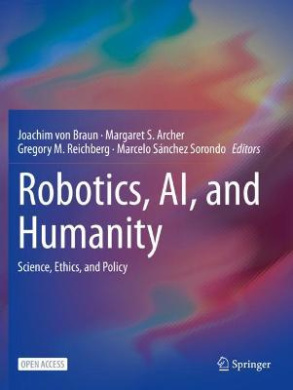
This open access book examines recent advances in how artificial intelligence (AI) and robotics have elicited widespread debate over their benefits and drawbacks for humanity. The emergent technologies have for instance implications within medicine and health care, employment, transport, manufacturing, agriculture, and armed conflict. While there has been considerable attention devoted to robotics/AI applications in each of these domains, a fuller picture of their connections and the possible consequences for our shared humanity seems needed. This volume covers multidisciplinary research, examines current research frontiers in AI/robotics and likely impacts on societal well-being, human – robot relationships, as well as the opportunities and risks for sustainable development and peace. The attendant ethical and religious dimensions of these technologies are addressed and implications for regulatory policies on the use and future development of AI/robotics technologies are elaborated. Joachim von Braun is Director of the Center for Development Research (ZEF), Bonn University, and Professor for economic and technological change. He received his doctoral degree in agricultural economics from the University of Goettingen, Germany. His research is on economic development, science and technology policy, poverty reduction, food and nutrition security, resource economics and trade. von Braun is President of the Pontifical Academy of Sciences of the Vatican; member of German National Academy of Science – Leopoldina, Academy of Science and Engineering (acatech), Academy of Arts and Science North Rhine-Westphalia, fellow of African Academy of Science and of American Association for the Advancement of Sciences. From 2002 to 2009, he was director general of the International Food Policy Research Institute (IFPRI) based in Washington DC. He was president of the International Association of Agricultural Economists (IAAE). Margaret S. Archer has a PhD from London School of Economics, is a sociologist, who spent most of her academic career at the University of Warwick, UK, where she was Professor of Sociology. She was also a professor at l’Ecole Polytechnique Fdrale de Lausanne, Switzerland. Professor Archer served as President of the Pontifical Academy of Social Sciences until 2019. She was President of the International Sociological Association 1986-90. Her research is in the area of philosophy of social science. It has fundamentally been concerned with the “problem of structure and agency”, that is with justifying these as irreducible entities with their own emergent properties and powers. She is working on the manner in which human reflexivity serves to mediate between our personal concerns and our structural conditioning as the next stage in the above project. Gregory M. Reichberg is Research Professor at the Peace Research Institute Oslo (PRIO) and Adjunct Professor in the Department of Political Science at the University of Oslo. He heads the Oslo-based Research School on Peace and Conflict (a consortium that offers doctoral courses) and is an associate editor of the Journal of Military Ethics. Reichberg leads Warring with Machines: Military Applications of Artificial Intelligence and the Relevance of Virtue Ethics, a four-year project funded by the Research Council of Norway’s Research Programme on the Cultural Conditions Underlying Social Change. He is author of Thomas Aquinas on War and Peace, which was named an “outstanding academic title 2017” by Choice Magazine. Marcelo Snchez Sorondo is Chancellor of the Pontifical Academy of Sciences and of the Pontifical Academy of Social Sciences since 1998. He is retired Professor of the History of Philosophy, Libera Universit Maria SS. Assunta (1998-2015). Ordained Bishop by His Holiness John Paul II on 19 March 2001, he is member of the Pontifical Academy of St. Thomas Aquinas (1989) and was Secretary Prelate (1999-2017); Member of the Accademia dei Georgofili (2008); Member of Academy of Sciences of Cuba (2009); Member of the Accademia Italiana del Vino (2010); Member of the Acadmie Catholique de France (2011). His early work centred around an innovative examination of the primary function of the idea of participation in the core theological approach of St. Thomas Aquinas. Drawing upon the most recent developments in critical research into the structure of the thought of Aristotle, Snchez Sorondo examined the different interpretations of this philosopher, especially those propounded during the medieval period by Thomas Aquinas and during the modern era by Hegel. 1. Introduction, overview and cross cutting conclusions. Joachim von Braun and co-editors (based on the conference concept and statement of the conference) I) FOUNDATIONAL ISSUES IN AI AND ROBOTICS 2. Could a robot be conscious? Lessons from philosophy. Markus Gabriel 3. Could a robot be conscious? Lessons from the cognitive neuroscience of consciousness. Stanislas Dehaene (based on 2017 SCIENCE article if approved) 4. Differences between Natural and Artificial Cognitive Systems. Wolf Singer 5. Foundations of artificial intelligence and effective universal induction. Jrg Zimmermann and Armin Cremers II) AI AND ROBOTICS CHANGING THE FUTURE OF SOCIETY (WORK, FARMING, SERVICES AND POVERTY) 6. Robotics and the global organization of production. Koen De Backer 7. AI/robotics implications for poverty and marginalization. Joachim von Braun 8. Robotics for sustainable Crop Production. Ciryll Stachniss 9. Robotics and AI for food security and innovation. Maximo Torero 10. Robotics in the classroom. Hopes or threats? Pierre Lna III) ROBOTICS, AI, AND MILITARIZED CONFLICT 11. Designing robots for the battlefield: state of the art. Bruce Swett 12. Military applications of AI and the relevance of virtue ethics. Gregory M. Reichberg and Henrik Syse 13. The use of AI in cyber war: ethical and regulatory challenges. Sophie-Charlotte Fischer 14. AI Winter or AI that Saves the World? – AI and nuclear deterrence. Nobumasa Akiyama IV) AI/ROBOT – HUMAN INTERACTIONS: REGULATORY AND ETHICAL IMPLICATIONS 15. Can Human Beings and AI Robots be Friends? Margaret Archer 16. Robots and rights. Wolfgang M. Schrder 17. Human-robot interactions and affecting computing: the ethical implications. Laurence Devillers 18. Humans Judged by Machines: the Rise of big data in Finance, Insurance, and Real Estate. Frank Pasquale 19. Impact of robotics/AI on human relations: the process of hybridization and how to deal with it. Pierpaolo Donati 20. What is it to implement human-robot joint action? Aurlie Clodic 21. Unpacking “Responsible robotics”. Aimee van Wynsberghe 22. Regulating AI: considerations that apply across domains. Angela Kane