Description
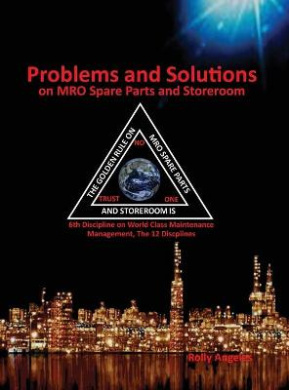
This is the 5th of a series of books about World Class Maintenance Management disciplines about MRO Spare Parts and Storeroom. It is written for industries with problems and searching for solutions to their MRO Spare Parts and Storeroom problems. MRO Spare Parts and Storeroom Management are some of the most neglected maintenance strategies in any maintenance optimization and strategies, which should not be the case. Others say that this is the missing link to any reliability and maintenance improvement. Almost every type of industry, whether from manufacturing, processing, pharmaceutical, power plants, mining, construction, aviation, oil, and gas, has a storeroom to keep their spare parts. There are two main goals of MRO Spare Parts and Storeroom, which are quite conflicting. First, this balances the cost of spares inventory and provides all the parts and supplies needed to keep the plant operating. It may sound conflicting or contradicting, but thinking about this thoroughly, it is really not conflicting if the MRO Storeroom is well managed. Second, the role of maintenance is to make the equipment available. Two of the main highlights of this book are to provide the reader an algorithm or MRO Decision Diagram to determine if a spare needs to be stock or not, and the second is to determine the correct quantity of parts to be stocked in our storeroom. Some of the highlights of this book include;Provide a decision-making process on whether to stock or not to stock parts through an MRO Decision Diagram or Algorithm How the MRO Algorithm or Decision Diagram is Used What can we do about squirrel stores and how to eliminate them permanently Different ways of analyzing MRO Spare parts Learn the basic”Golden Law” on MRO Spare Parts Management Learn several options on what to do for obsolete parts inside the storeroom Learn one option on what to do with non-moving parts Learn why not all critical parts need to be stuck in the storeroom Learn important factors to consider before making a decision on whether to stock or not to stock parts in the storeroom Learn a much better way of determining the minimum quantity to be stored besides min-max and EOQ calculation How to address squirrel stores permanently Provide the reader with a step by step roadmap on how to finally improve their MRO Storeroom Understand who are the best people or function to handle the maintenance storeroom and why Learn that one of the most important functions of the storekeeper is to maintain and care for the spare parts Different methods on Automating MRO Spare Parts and Storeroom Why improving the storeroom should be done inside and outside the storeroom and many more 99.99% of all the problems on MRO Spare Parts and storerooms are man-made, and they may come from different departments or functions of the organization. If man created the problem, let the man find the solution to their MRO Spare parts and storeroom problems. This book starts with a survey on the different problems common to industries on their MRO Spare Parts and Storeroom. As you read each chapter, it will provide the reader with a clear understanding of dealing with each of these problems. On the contrary, we cannot simply stock every single part of every piece of equipment we have in the plant if your industry still wants to remain in business. Rolly is a seasoned international maintenance and reliability consultant with over 30 years of solid experience in the field. He has been invited to different countries and has conducted reliability and maintenance training in United Arab Emirates, Qatar, India, Malaysia, Indonesia, Brunei, Thailand, Nigeria, Bangladesh, South Africa, China, and Botswana. His maintenance training portfolio includes maintenance and reliability courses on TPM, Lubrication, Tribology, Condition-Based Maintenance, RCM, RCFA, TPM Planned Maintenance, Autonomous Maintenance 7 Steps, World Class Maintenance Management, The 12 Disciplines, Oil Contamination Control, Maintenance Indices, and KPI’s, Maintenance and Reliability Management Strategies and much more. Rolly previously worked with Amkor Technology Philippines as a TPM Senior Engineer, an industry engaged in manufacturing Integrated Circuit products and spearheaded their Planned Maintenance organization, composed of maintenance managers and engineers. He was also responsible for dramatically reducing unplanned breakdowns in their TPM Journey and RCM implementation on their Facilities AHU units and substation equipment. Rolly is currently working as an independent reliability and maintenance consultant. Rolly is a graduate of Mechanical Engineering from Mapua Institute of Technology in the Philippines, batch 1985, and passed the licensure board examination the following year in 1986. With 30 years of solid experience, he had worked in various industries from shipping, woodworking, foundry, cast-iron machining, assembly lines, semiconductor manufacturing, and the mining industry. Here, he gained hands-on experience and understanding of TPM and RCM, respectively, a strategy from both the west and the east. His last corporate employment was in 2002, where he worked as a technical training specialist at Lepanto Consolidated Mining Industry. In 2005, Rolly retired early from the industry and decided to establish his own consulting business, RSA Reliability and Maintenance Consultancy Firm, where he dedicates his time and passion for working as an independent reliability and maintenance consultant. He provides in-house training, consultation, and facilitation to different maintenance and reliability best practices.