Description
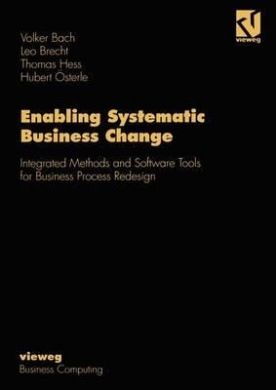
An increasing number of companies regard Business Process Redesign (BPR) as a significant means of improving their competitive position. The initial euphoria is being superseded by a more pragmatic assessment. This book demonstrates how a systematic, practical yet creative procedure can lead to more reliably successful BPR projects. Case studies and investigations support the superiority of a systematic, method-based approach as opposed to an “intuitive” one.Consequently, before the start of a project a method must be selected which corresponds to the strategic goals of the project and is suited to the company environment. This book formulates the central principles and criteria for this, which are derived from practical experience. A procedural model and checklists help the reader to define what he requires from the method. From these criteria are then derived suitable BPR tools. Of particular importance here is the underlying cost-benefit analysis.The book describes over a dozen BPR methods and as many tools within a uniform framework. This ensures comparability and allows correlation with project-specific requirements. Particular attention is paid to method-tool combinations that are designed for combined use.Immer mehr Unternehmen sehen im Business Process Redesign (BPR) ein wesentliches Mittel, ihre Wettbewerbsfhigkeit zu steigern. Die anfngliche Euphorie weicht heute einer sachlicheren Betrachtung. Das Buch zeigt auf, warum ein systematisches, ingenieurmiges, aber gleichzeitig kreatives Vorgehen sicherer zu erfolgreichen BPR-Projekten fhrt.Fallstudien und empirische Untersuchungen untermauern die berlegenheit des systematischen, methodisch untersttzten gegenber dem “intuitiven” Ansatz. Dementsprechend ist vor Projektbeginn eine Methode auszuwhlen, die der strategischen Zielsetzung des Projekts entspricht und in das Unternehmensumfeld pat. Das Buch formuliert dafr die zentralen, aus der Praxis abgeleiteten Grundstze und Kriterien. Ein Vorgehensmodel Dipl.-Wirtsch.-Inf. Volker Bach, Dr. Leo Brecht, Dipl.-Wirtsch.-Inf. Thomas Hess und Prof. Dr. Hubert sterle verfgen ber umfangreiche Projekterfahrungen im Redesign von Organisationen sowie in der Informationssystem-Entwicklung. Sie arbeiten federfhrend an der Entwicklung von Methoden und Tools fr das Business Process Redesign, deren Ergebnisse u. a. durch eine Reihe von Monographien breiten Anwenderkreisen vertraut sind. Im Rahmen des Forschungsprogramms “Informationsmanagement HSG” an der Universitt St. Gallen findet Forschung in enger Kooperation mit fhrenden Unternehmen statt. Auf diese Weise knnen die Autoren stets in der Praxis validierte Ergebnisse prsentieren. Case studies: successful BPR projects – Empirical investigations: the significance of method and tools – Systematic selection of BPR methods: principles, procedures, criteria – Implications for tool selection – Market analysis: the 13 most important BPR methods – Comparison of 16 suitable tools – Integrated method-tool-combinations – 10 trends in systematic BPRFallstudien: erfolgreiche BPR-Projekte – Empirische Untersuchung: die Bedeutung von Methoden und Tools – Systematische Auswahl von BPR-Methoden: Grundstze, Vorgehen, Kriterien – Konsequenzen fr die Toolauswahl – Marktanalyse: die 13 wichtigsten BPR-Methoden – 16 passende Tools im Vergleich – Integrierte Methoden-Tool-Kombinationen – Die 10 Trends im systematischen BPR