Description
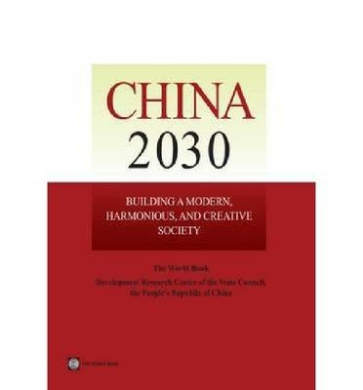
China should complete its transition to a market economy through enterprise, land, labor, and financial sector reforms, strengthen its private sector, open its markets to greater competition and innovation, and ensure equality of opportunity to help achieve its goal of a new structure for economic growth. These are some of the key findings of China 2030, a joint research report by a team from the World Bank and the Development Research Center of China’s State Council. This report lays out the case for a new development strategy for China to rebalance the role of government and market, private sector and society to reach the goal of becoming a-high income country by 2030. China 2030 recommends steps to deal with the risks facing China over the next 20 years, including the risk of a hard landing in the short term, as well as challenges posed by an ageing and shrinking workforce, rising inequality, environmental stresses, and external imbalances. The report lays out six strategic directions for China’s future: * Completing the transition to a market economy; * Accelerating the pace of open innovation; * Going “green” to transform environmental stresses into green growth as a driver for development; * Expanding opportunities and services such as health, education and access to jobs for all people; * Modernizing and strengthening its domestic fiscal system; and * Seeking mutually beneficial relations with the world by connecting China’s structural reforms to the changing international economy.| The general perception of modern Latin American political institutions emphasizes a continuing and random process of disorder and crisis, continually out of step with other regions in their progress toward democracy and prosperity. In History of Political Parties in Twentieth-Century Latin America, Torcuato S. Di Tella demonstrates that this common view lacks context and comparative nuance, and is deeply misleading. Looking behind the scenes of modern Latin American history, he discerns its broad patterns through close analysis of actual events and comparative sociological perspectives that explain the apparent chaos of the past and point toward the more democratic polity now developing. Di Tella argues that although Latin America has peculiarities of its own, they must be understood in their contrasts–and similarities–with both the developed centers and undeveloped peripheries of the world. Latin American societies have been prone to mass rebellions from very early on, more so than in other regions of the world. He analyzes, as well, such significant exceptions to this pattern as Chile, Colombia, and, to a large extent, Brazil. Turning to the other side of the social spectrum, he shows how the underpriviledged classes have tended to support strongman populist movements, which have the double character of being aggressive toward the established order, but at the same time repressive of public liberties and of more radical groups. Di Tella provides here a necessary examination of the concept of populism and divides it into several variants. Populism, he maintains, is by no means disappearing, but its variants are instead undergoing important changes with significant bearing on the region’s near-term future. History of Political Parties in Twentieth-Century Latin America is rich in historical description, but also in its broad review of social structures and of the strengths and weaknesses of political institutions. Choice commented that “this heavily documented volume with an extensive bibliography would prove valuable to researchers and advanced students of Latin America.”